 Facebook
 X
X
 Pinterest
 Copy Link
If you’ve bought or sold a home, you’ve probably heard of radon. Many people know it has something to do with basements and health concerns, but few people understand what radon actually is.
The good news is that radon very manageable once you understand it.
What Is Radon?
Radon is a naturally occurring gas.
It is created deep underground as tiny amounts of uranium in rocks and soil slowly break down over time.
Tiny amounts of uranium are naturally present in virtually all soil and rock around us.
The rocks and soil beneath your home may have been there since the time of the dinosaurs—or even longer. For millions of years, small amounts of uranium have been slowly breaking down as part of a completely natural process.
One of the byproducts of that process is radon gas.
How Does Radon Get Into a House?
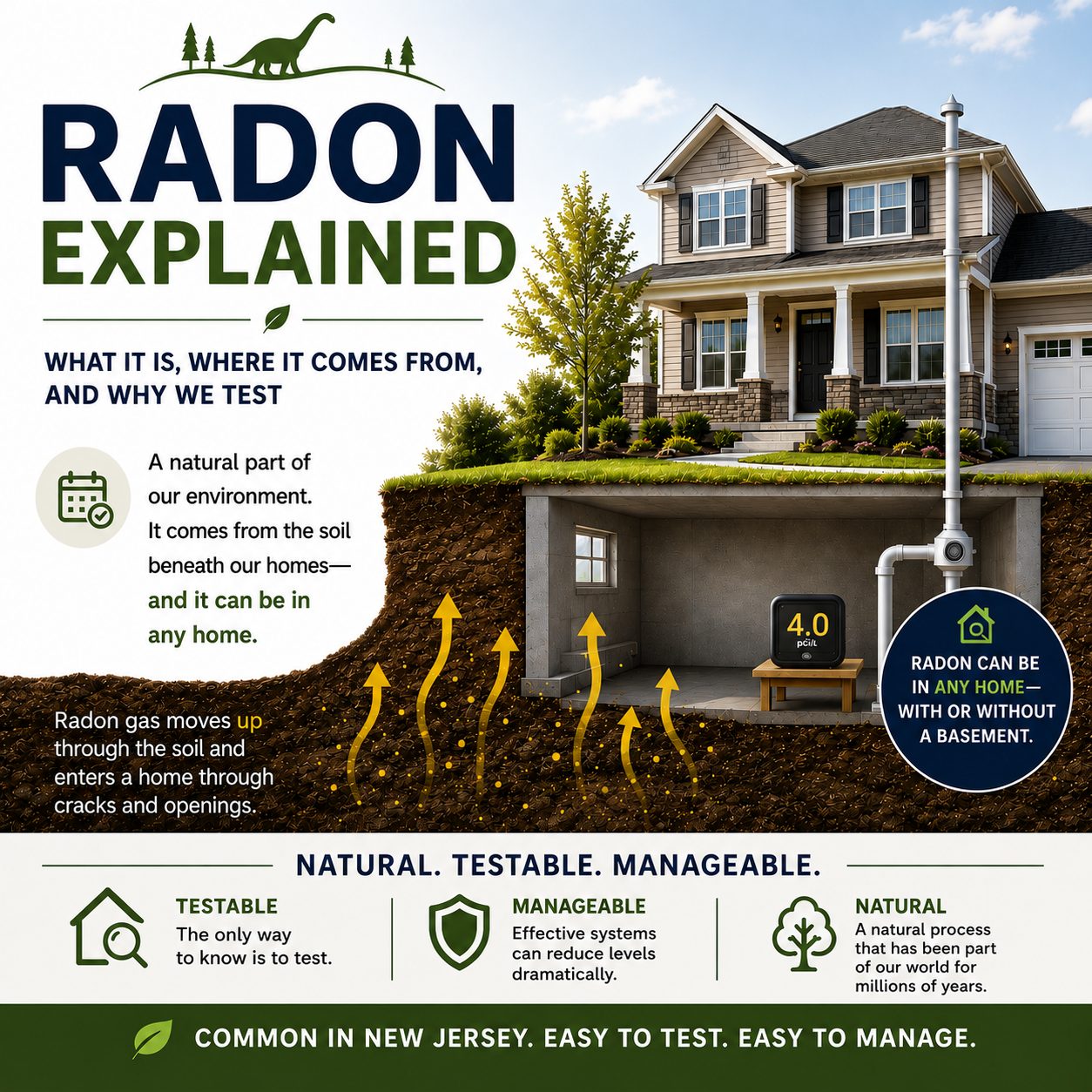
Because radon is a gas, it can move through the soil and enter a home through:
- Small foundation cracks
- Gaps around pipes
- Sump pits
- Utility penetrations
- Crawl spaces
- Expansion joints in concrete slabs
Many people associate radon with basements, but radon can be found in homes with basements, crawl spaces, and slab foundations. The gas comes from the soil beneath the home—not from the basement itself.
Once inside, radon may accumulate if it enters the home faster than it flows out of the house.
Why Is Radon a Health Concern?
Here’s an important detail many people don’t realize.
Radon gas itself naturally breaks down, creating tiny particles.
These particles can attach to dust and other airborne particles in the home.
When inhaled, some of these particles can become trapped in the lungs.
Over many years, this radiation can damage lung tissue and increase the risk of lung cancer.
The risk comes from long-term exposure to elevated levels.
Why Do New Jersey Buyers Hear So Much About Radon?
If you’re relocating to New Jersey from another state—or another country—you may be surprised that radon testing is commonly recommended during the home-buying process.
The reason is simple: radon is relatively common in many parts of New Jersey, including much of Central New Jersey.
Radon is created naturally as tiny amounts of uranium in the soil and rock beneath us slowly break down over time. Because of the geology in our region, radon testing has become a routine part of many real estate transactions.
A common misconception is that radon is only found in homes with basements. In reality, radon comes from the soil beneath the home and can be present in homes with basements, crawl spaces, or slab foundations.
For local buyers, a radon test is often considered just another part of due diligence, much like a home inspection, termite inspection, or well water test.
Radon levels can vary from one property to another—even between neighboring homes—so testing provides useful information about a specific property at a specific point in time.
How Do You Know If a Home Has Radon?
You can’t see it.
You can’t smell it.
You can’t taste it.
The only way to know is to test.
Fortunately, testing is simple and inexpensive. Short-term test kits are widely available, and professional testing is commonly performed during real estate transactions.
The EPA recommends taking action if radon levels are 4.0 pCi/L (picocuries per liter) or higher.
What Happens If Radon Levels Are High?
The good news is that elevated radon levels are usually very manageable.
A radon mitigation system typically uses a pipe and fan system to draw radon gas from beneath the home and safely vent it above the roof before it enters the living space.
These systems are highly effective and can often reduce radon levels dramatically.
The Bottom Line
Radon is a naturally occurring part of our environment. Tiny amounts of uranium have existed in the rocks and soil beneath us for millions of years, slowly producing radon gas as part of a natural process.
In Central New Jersey, radon testing is common, understanding it is helpful, and managing it is straightforward. Like many aspects of homeownership, the key is simply being informed.
The good news is that radon can be tested, measured, and, when necessary, effectively managed.
About Mary Churchill