 Facebook
 X
X
 Pinterest
 Copy Link
 You may have heard that the Federal Reserve (“the Fed”) left interest rates unchanged yesterday.
What does that tell us?
In simple terms, it suggests that inflation has improved but is not yet fully under control. At the same time, the economy remains relatively healthy, so the Fed is taking a “wait and see” approach before making its next move.
But what does that mean for consumers, and how does it affect mortgage rates?
First: What Is Inflation?
Inflation simply means prices are rising over time.
When inflation is high, things like groceries, gasoline, insurance, restaurant meals, and housing become more expensive.
In other words, your money doesn’t go as far as it used to.
Second: What Is the Federal Reserve?
The Federal Reserve is the central banking system of the United States.
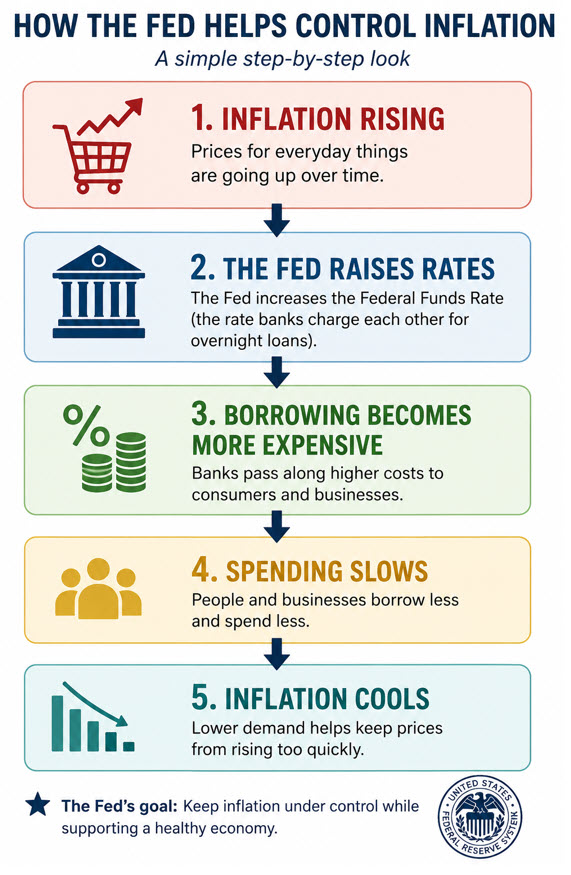
One of its most important jobs is helping keep inflation under control.
The Fed doesn’t set the prices of homes, groceries, or gasoline. Instead, it influences how much money is being borrowed and spent throughout the economy.
Third: How Does the Fed Control Inflation?
The Fed’s primary tool is the Federal Funds Rate.
This is the interest rate banks charge each other for very short-term loans, usually overnight.
Banks are required to maintain certain reserves and often need to borrow money from one another to meet those requirements.
The interest rate they pay each other is called the Federal Funds Rate.
Fourth: What Happens When the Fed Raises Rates?
When the Fed raises the Federal Funds Rate, borrowing becomes more expensive for banks.
Banks often pass some of those higher costs along to consumers and businesses.
As a result:
• Credit card rates may rise
• Auto loan rates may rise
• Business loan rates may rise
• Home equity loan rates may rise
The key point is this:
When borrowing becomes more expensive, consumers and businesses tend to spend less.
Fifth: Why Does Spending Less Help Reduce Inflation?
At its core, inflation is often a supply-and-demand issue.
When lots of people are competing to buy the same things, prices tend to rise.
Think about a home receiving multiple offers. Buyers compete, and the price often gets pushed higher.
The same principle applies throughout the economy.
When demand cools, sellers have less ability to keep raising prices.
The Fed’s goal is to slow demand enough to keep prices from rising too quickly.
Sixth: So What About Mortgage Rates?
This is where many people get confused.
The Fed does not directly set mortgage rates.
Mortgage rates are based largely on where lenders and investors believe inflation and interest rates are headed in the future.
That’s why mortgage rates don’t always move immediately when the Fed changes rates.
Sometimes mortgage rates fall before the Fed cuts rates.
Sometimes mortgage rates rise even when the Fed leaves rates unchanged.
Mortgage rates and the Federal Funds Rate are related, but they are not the same thing.
What Does This Mean for Home Buyers?
Many buyers are waiting for mortgage rates to fall before purchasing a home.
The challenge is that if rates fall significantly, more buyers may enter the market.
More buyers can mean more competition.
More competition can push home prices higher.
That’s why waiting for lower rates doesn’t always save money.
The best time to buy is usually when:
• You are financially ready
• You find a home that meets your needs
• The monthly payment fits comfortably within your budget
If rates fall later, you may be able to refinance.
A One-Year Example
Let’s assume a buyer purchases a $559,000 home today with 20% down and a 6.5% mortgage rate.
Purchase Price: $559,000
Down Payment (20%): $111,800
Loan Amount: $447,200
Monthly Principal & Interest Payment: Approximately $2,826
If mortgage rates were to fall by 1% and the buyer refinanced, the monthly payment could decrease by approximately $287 per month.
That’s about $3,444 in savings over one year.
Now let’s look at the home itself.
If a $559,000 home were to increase in value by 6% over the next year—a rate similar to what we’ve seen in many local markets in recent years—that home would gain approximately $33,540 in value.
Of course, future appreciation is never guaranteed, and no one knows exactly what home prices or interest rates will do next year.
But this example highlights an important point:
Buyers often focus on the cost of the mortgage while overlooking the cost of the house itself.
The amount saved by waiting for a lower mortgage rate may be much smaller than the amount paid if home prices continue to rise.
That’s why waiting for lower rates doesn’t automatically save money.
Key Takeaway
You can refinance a mortgage. You can’t go back and buy a house at yesterday’s price.
Final Thought
The best home-buying decisions are usually based on your finances, your goals, and your timing—not on trying to perfectly predict future interest rates.
This article is intended for general informational purposes only and should not be considered financial, legal, or mortgage advice.
About Mary Churchill
Mary Churchill has been helping buyers and sellers navigate the Central New Jersey real estate market since 2002. Whether you’re relocating to the area or selling your current home, she believes informed buyers make better decisions.
Mary Churchill, Realtor®
Coldwell Banker Realty
908-930-4800
mary.churchill@cbmoves.com
Serving buyers and sellers throughout Middlesex, Somerset, Union, and surrounding Central New Jersey counties.
Mortgage Questions?
Belal Khalid
VP Mortgage Lending, Guaranteed Rate Affinity
NMLS #2076564
609-294-4412